
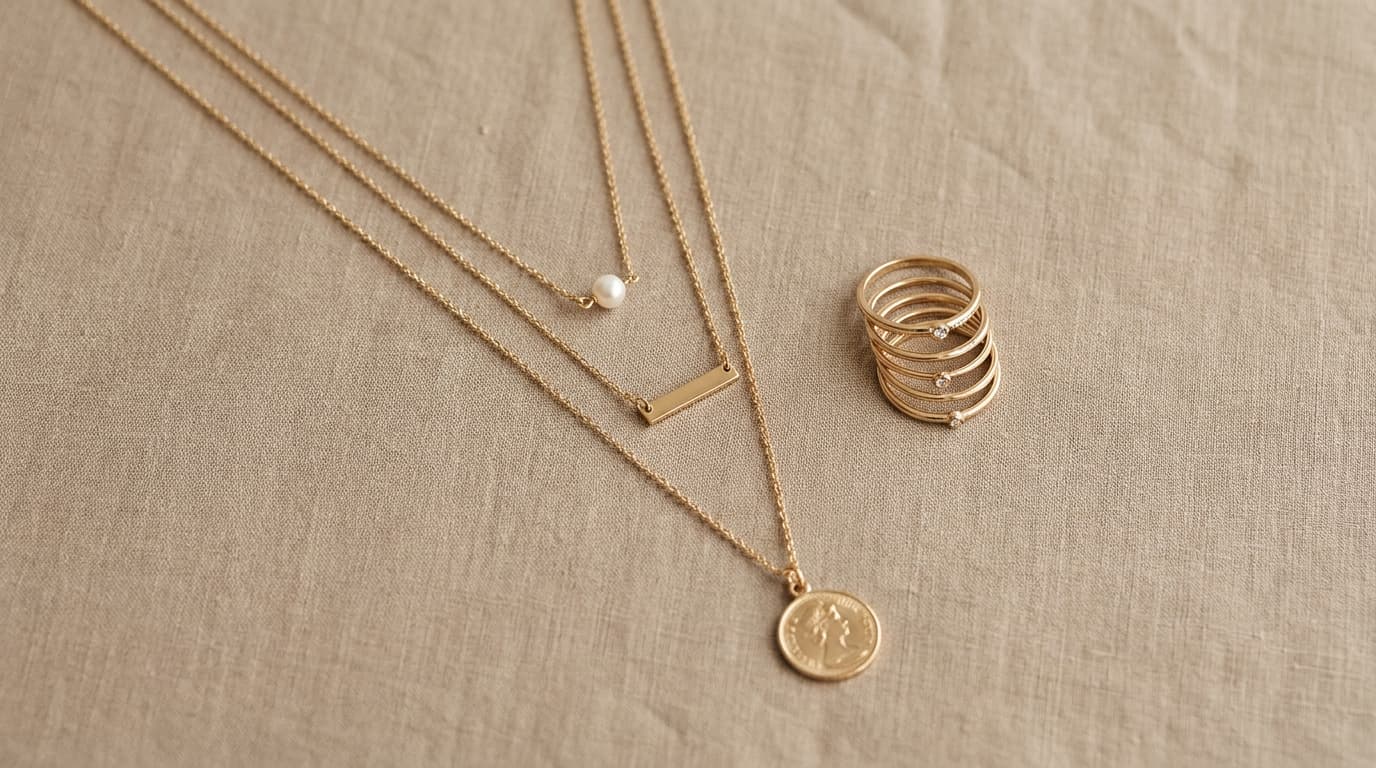
Layering is the most copied jewellery look and the most commonly botched. The pieces are usually fine. The spacing is what goes wrong.
The spacing rule for necklaces
Layered chains need visible gaps between them. Aim for at least 5–6 cm of difference in length between each chain. Anything closer and they sit on top of each other, tangle constantly, and read as one thick messy chain rather than three deliberate ones. Three chains is the sweet spot; four is possible but needs real length differences.
A reliable set of lengths:
- Short, around 40 cm — sits at the base of the neck
- Mid, around 46 cm — sits just below the collarbone
- Long, around 55 cm — sits on the chest, usually the one with a pendant
Vary the weight, not just the length
Three chains of identical thickness look like a mistake. Mix one fine chain, one slightly chunkier, and one with a pendant or a detail. The variation is what makes it look considered. If every chain is the same weight, the eye reads it as a single object.
How do I stop layered chains from tangling?
- Put the shortest chain on first and the longest on last.
- Do not layer two chains of nearly the same length. That is where almost all tangling starts.
- Fasten clasps at slightly different points around the back rather than stacking them all at the nape.
- Store them hanging or clasped separately. Most tangling happens in a drawer, not on your neck.
Stacking rings
Rings follow the opposite logic to necklaces: they want to touch. Stacked rings should sit flush against each other, not spread across the finger with gaps. Two or three on one finger, or a spread across two adjacent fingers, both work. One ring per finger across all five reads as cluttered rather than stacked.
Keep the stack on one hand. A heavy stack on both hands is the single most common way this look tips into too much. If you wear a watch, stack on the opposite hand.
Can I mix gold and silver tones?
Yes, and it usually looks better than people expect — but commit to it. Mixing works when it is clearly deliberate: a mixed-metal piece somewhere in the stack, or a roughly even split. One silver ring in an otherwise gold-toned stack looks like you lost the matching one.
Everyday practicalities
Layered chains catch on scarves, dupattas and collared shirts. Stacked rings catch on knitwear and bags. If you are wearing either through a full working day, favour smoother pieces with fewer protruding details. Take the whole stack off before sleeping — a night of movement does more damage to fine chains than a week of wear.
Adjustable bands are the easiest entry point into stacking because they need no sizing. Our rings and pendant chains are built around this kind of repeat, layerable wear.