The short answer: measure your finger in millimetres, not in guesses
Wrap a thin strip of paper around the base of the finger you want the ring on, mark exactly where the ends overlap, then lay the strip flat against a ruler and read the length in millimetres. That length is your finger circumference, and it is the only number that actually matters. A circumference of 51.8 mm is roughly an Indian size 12. 54.4 mm is roughly a size 14. 56.9 mm is roughly a size 16.
Everything else in this guide is about getting that number right, understanding why it moves around by a full size between a May afternoon in Nagpur and a January morning in Shimla, and knowing when the honest answer is to skip sizing altogether and buy an adjustable ring.
How to measure your ring size at home
You do not need a ring sizer. You need paper, a pen and a ruler with millimetre markings, plus the patience to measure three times, because a single measurement is almost always wrong.
Method 1: The paper strip (most reliable at home)
Cut a strip of ordinary printer paper about 5 mm wide and 10 cm long. Printer paper is the right stiffness and notebook paper works. Newspaper does not, because it stretches and tears when it gets damp from your skin.
- Wrap the strip around the base of your finger, snug but not tight. It should feel like a ring already on your hand, not like a rubber band.
- Mark the overlap point with a fine pen. A ballpoint marks more precisely than a gel pen here.
- Slide the loop off over your knuckle without unwrapping it. If it will not come off, the knuckle is bigger than the base and you have a separate problem, covered further down.
- Lay the strip flat and measure from the end to your mark, in millimetres.
- Repeat twice more, cutting a fresh strip each time. Use the largest of the three readings.
Use the largest reading, not the average. A too-tight measurement gives you a ring that will not go on at all, which is a total loss. A slightly loose ring can still be worn on a thicker finger or stacked with another ring to hold it in place.
Method 2: Measure a ring you already own
If you have a ring that fits the same finger comfortably, this is faster and more accurate. Place it on a ruler and measure the inside diameter, edge of the inner wall to edge of the inner wall, in millimetres. Then multiply by 3.14 to get the circumference.
A 16.5 mm inside diameter is 51.8 mm circumference, which is Indian size 12. Measuring the outside diameter is the classic mistake here and will push you up a full size or two, depending on how thick the band is.
If the ring you own fits a different finger, do not convert. Ring fingers, index fingers and middle fingers on the same hand routinely differ by two or three Indian sizes.
Method 3: The thread method (use only if you have nothing else)
Thread and string stretch. If thread is genuinely all you have, wrap it, mark it, measure it, and subtract about 1 mm to compensate for the stretch you cannot feel. It is a rough correction, not a precise one.
What not to do: printed sizers on a phone screen
Many sites offer a printable chart where you match your ring against printed circles. This works only if the page prints at exactly 100 percent scale on A4, which most home printers do not do by default. It fails completely if you hold the ring against your phone screen, because screen sizes and pixel densities vary. Two different phones will show the same size 14 circle at visibly different diameters. Use paper and a ruler instead.
Indian ring size chart: circumference, diameter and US equivalent
Indian ring sizes run as plain numbers, most commonly from about 6 to 26. The useful rule to remember: an Indian size is roughly double the US size. Indian 12 is US 6. Indian 16 is US 8. Indian 20 is US 10.
Here are the sizes that cover the vast majority of Indian women's fingers:
- Indian 8 — 46.8 mm circumference — 14.9 mm inside diameter — US 4
- Indian 10 — 49.3 mm — 15.7 mm — US 5
- Indian 11 — 50.6 mm — 16.1 mm — US 5.5
- Indian 12 — 51.8 mm — 16.5 mm — US 6
- Indian 13 — 53.1 mm — 16.9 mm — US 6.5
- Indian 14 — 54.4 mm — 17.3 mm — US 7
- Indian 15 — 55.7 mm — 17.7 mm — US 7.5
- Indian 16 — 56.9 mm — 18.1 mm — US 8
- Indian 17 — 58.2 mm — 18.5 mm — US 8.5
- Indian 18 — 59.5 mm — 18.9 mm — US 9
- Indian 20 — 62.0 mm — 19.7 mm — US 10
- Indian 22 — 64.6 mm — 20.6 mm — US 11
Each Indian size step is about 1.27 mm of circumference, or roughly 0.4 mm of diameter. That is small, and it is why a measurement 2 mm off puts you a size and a half away from the right ring.
An honest caveat: sizing charts are not perfectly standardised across Indian sellers, and two brands can label the same physical ring size 13 and size 14. If a seller publishes a millimetre measurement alongside the size number, trust the millimetres. If they publish only a number, expect to land within half a size, not exactly on it.
Your ring size is not one number, and India makes that worse
Fingers are not fixed objects. They swell and shrink with heat, humidity, salt, activity and time of day. In most of India this swing is large enough to matter.
- Heat. In April, May and June across most of the country, fingers run visibly fuller. Blood vessels near the skin dilate to shed heat. A ring that slides on easily in December can need a twist to get past the knuckle in May.
- Humidity and monsoon. Coastal and high-humidity cities like Mumbai, Chennai, Kochi and Kolkata combine heat with moisture retention. Many people are a half size larger through the monsoon months than they are in winter.
- Time of day. Fingers are smallest in the early morning and largest in the late afternoon and evening, after you have been upright and active. Measuring at 7 am and buying to that number is one of the most common ways people end up with a ring that will not go on.
- Salt and food. A meal heavy on pickle, papad, packaged snacks or restaurant food will show up in your fingers the next morning.
- Cold. Hill stations, air-conditioned offices set to 18 degrees, long flights and north Indian winters all change the fit. A ring sized in a Delhi January can feel tight in a Goa July, and that direction is the painful one.
The practical rule: measure in the evening, at normal room temperature, when your hands are warm and dry. Do not measure right after a workout, right after washing dishes in hot water, or when your hands are cold. If you land exactly between two sizes, go up. A ring you cannot get on is useless. A ring that is slightly loose is wearable.
The knuckle problem
Some people have a knuckle noticeably wider than the base of the finger. If your paper loop will not slide off over the knuckle at all, you are one of them, and the base measurement alone will fail you.
Measure both: the base of the finger, and the widest point of the knuckle. If the knuckle reading is more than about 2 mm larger, size to a point between the two, closer to the knuckle. The ring needs to clear the knuckle to go on, but if you size fully to the knuckle it will spin freely and slide around all day at the base.
For fashion rings in the ₹199 to ₹599 band, an adjustable open-band design solves this outright, because the gap lets the ring widen to pass the knuckle and then settle at the base. This is the single best reason to buy adjustable.
Band width changes the fit more than people expect
A wide band contacts more of your finger, so it feels tighter at the same nominal size. The wider the band, the more true this is.
- Under 3 mm wide (thin bands, most stacking rings): buy your measured size.
- 4 to 6 mm wide (standard statement bands, most cocktail rings): consider going up half to one Indian size.
- Over 7 mm wide (chunky bold bands): go up one full Indian size, sometimes more.
Profile matters too. A ring with a rounded, domed inside edge slides over a knuckle far more easily than one with a flat inside and sharp square edges, even at identical measurements. Flat-inside bands in wide widths are the least forgiving thing you can buy without trying on.
Chunky stone-set rings add another wrinkle: the weight sits on one side, so a slightly loose ring will rotate and leave the stone facing your palm. For heavy-topped designs, err tighter than you would for a plain band.
When to just buy an adjustable ring
Adjustable rings are not a compromise in fashion jewellery. They are often the correct choice, and they dominate the under-₹500 category for good reason. An adjustable ring has an open back where the two ends of the band overlap or sit apart, and you widen or narrow the gap by hand. Buy adjustable when:
- You are buying a gift and do not know the recipient's size. This is the biggest use case. A fixed-size ring here is a gamble you will usually lose.
- Your knuckle is wider than your finger base.
- You want to move the ring between fingers, common with statement rings that read well on both the index and middle finger.
- You live somewhere with a large seasonal swing and do not want a ring that fits only half the year.
The honest limitations of adjustable rings
They are not infinitely adjustable, and nobody tells you this at the point of sale. A typical adjustable fashion ring comfortably covers a range of roughly three to four Indian sizes, say 12 to 16. Pushing beyond that either leaves a gap so wide it looks unfinished, or forces the band so closed that it distorts.
More importantly, metal fatigue is real. The base metal in fashion rings, usually brass or a zinc alloy under plating, work-hardens each time you bend it. Bend the same spot back and forth enough times and it will crack. Adjust the ring once when you get it, then leave it alone. Do not adjust it daily to move it between fingers. If you need it on two fingers regularly, buy two.
Also worth knowing: adjusting the band flexes the plating at the bend point. That is where gold tone wears off first on an adjustable ring. Handle the band by its sides when adjusting, not by the decorated front.
Stacking rings: sizing a set that works together
Stacked rings sit differently from single rings. Two or three thin bands on one finger behave collectively like one wider band, so the same tightening effect applies.
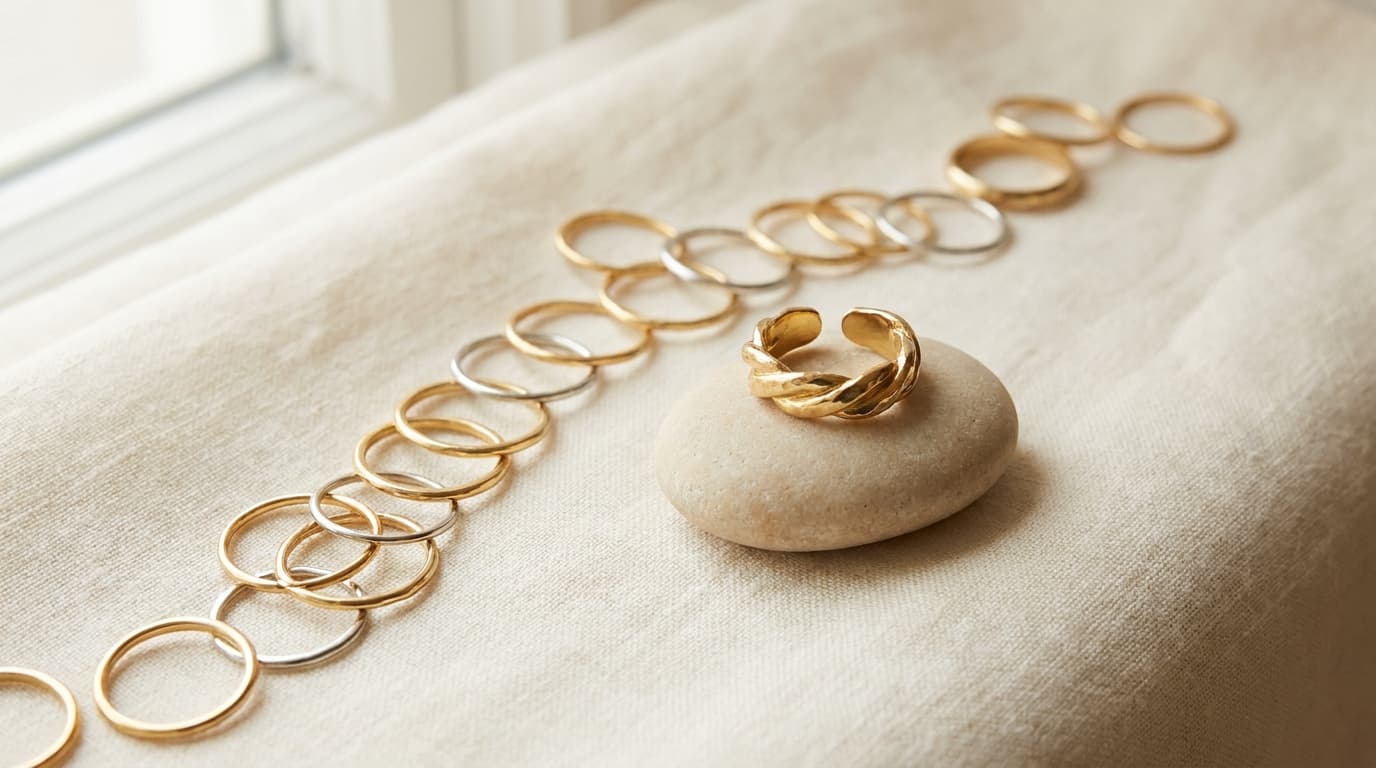
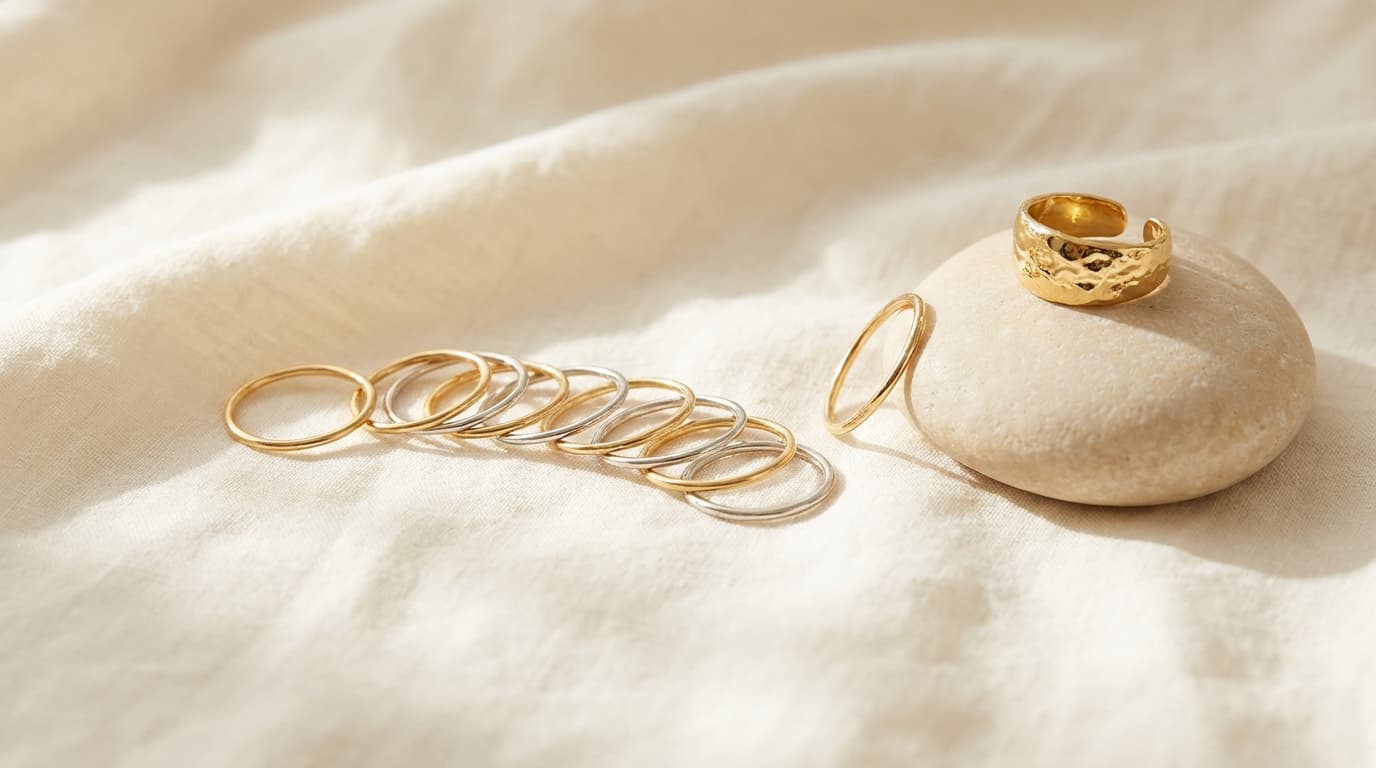
- For a stack of two or three bands under 2 mm each, buy your measured size for the lowest ring and consider going up half a size for the ones above it, since they sit higher up the finger where it is slightly wider on most hands.
- Stacks look best with an odd count, usually three, or as two on one finger and one on an adjacent finger.
- Mixing gold tone and silver tone works. Three different tones usually reads as accidental. Keep one dominant and use the second as a single accent.
- A stack on the index finger reads bolder. A stack on the ring finger of the right hand is the quieter, office-safe version. For a formal Indian workplace, a three-ring stack plus a bangle plus a watch on the same arm is too much metal, so drop the bangle.
Which finger, and what suits your hand
There is no rule you have to follow, but there are patterns that consistently look better.
- Shorter fingers: thin to medium bands, vertical designs and open shapes elongate the finger. A very wide band across a short finger visually shortens it further.
- Longer fingers: you can carry chunky bands and large stones that would overwhelm a shorter hand. This is where bold cocktail rings work best.
- Index finger: the most visible finger when you gesture, and the natural home for a statement piece.
- Middle finger: balanced and neutral. Good for chunky designs without seeming loud.
- Ring finger, right hand: the safest place for a delicate ring you want to wear daily.
- Thumb: thumb rings need a considerably larger size, often four to six Indian sizes above your ring finger. Do not assume.
On metal tone, the useful distinction is undertone rather than depth. Warm and olive undertones, the most common across India, sit very comfortably with gold tone and rose gold. Cooler undertones look sharper in silver tone and rhodium. If you are unsure, hold both against the inside of your wrist in daylight and see which recedes into your skin and which stands apart. Neither answer is wrong.
What fashion rings are made of, and why you cannot resize them
Fashion jewellery rings under ₹1,499 are typically brass or a zinc-based alloy with an electroplated finish, or stainless steel. Each behaves differently.
- Brass with gold or rose gold plating. Warm colour, holds detail well. The plating is thin, measured in microns, and wears at contact points. Rings wear faster than earrings because hands touch everything.
- Zinc alloy. Common in chunky cast designs because it moulds into complex shapes cheaply. Softer than brass and more prone to bending permanently if you sit on it or catch it in a bag zip.
- Stainless steel. The most durable option in this price band. It does not tarnish and survives water. Trade-off: designs are simpler because steel is harder to cast into fine detail, and the colour is a cooler grey unless it is gold-tone PVD coated.
- Rhodium over brass. A bright white finish that resists tarnish reasonably well. Plain silver plating without a protective top coat dulls faster.
Here is the part that matters for sizing: plated fashion rings cannot be resized. Resizing means cutting the band, removing or adding metal and soldering it back. The heat destroys the plating at the join, and the seam shows. A jeweller will usually decline, and if they do it, you will see the repair. This is exactly why measuring correctly before you buy is worth the ten minutes, and why adjustable designs are so popular in this category.
If nickel sensitivity is a concern for you, look for pieces described as nickel-free, and prefer stainless steel. Rings are in constant contact with skin that also gets sweaty, soapy and wet, so they trigger reactions more readily than earrings do for many people.
Buying rings online in India: what to check before you pay
Sizing is the main reason rings get returned, so check these before you order.
- Does the listing give a millimetre measurement? Inside diameter or circumference in mm is the useful number. A bare size label is less reliable across brands.
- Is it adjustable? If yes, and it says so clearly, most sizing anxiety disappears.
- What is the return window, and does it cover size exchange? Some sellers accept damage returns but not fit returns. Check before you order, not after.
- What is the band width? Cross-reference against the width guidance above.
- What is the actual material? The word Gold in a product name at a ₹399 price point means gold-toned plating, not gold. That is expected in fashion jewellery, but you should know what you are buying and how to care for it.
If you are buying as a gift and cannot ask the size directly, the easiest trick is to borrow a ring the person already wears, measure the inside diameter, and return it before it is missed. Failing that, buy adjustable, or buy earrings instead, which have no sizing problem at all.
Making a plated ring last
Rings take more abuse than any other category of jewellery. They get soap, sanitiser, cooking oil, detergent, turmeric and friction, all day. Plating is thin. Treat it accordingly.
- Remove rings before washing hands, cooking and cleaning. Detergent and dishwashing liquid strip plating faster than anything else in a normal day. Keep a small dish near the kitchen sink and the bathroom basin so taking them off is easy enough that you actually do it.
- Hand sanitiser is harsh on plating. Alcohol gel that pools under a ring dulls the finish. If you sanitise often, take the ring off or wipe underneath it afterwards.
- Turmeric stains. Haldi discolours light-toned plating and lodges in crevices around stone settings. Take rings off before you cook, and definitely before a haldi ceremony.
- Last on, first off. Rings go on after moisturiser, sunscreen and perfume, and come off before all of it.
- No gym, no swimming, no sleeping in them. Weights bend and scratch bands. Chlorine and salt water attack plating. Sleeping in rings snags them on bedding and deforms thin bands.
- Store them dry and separated. Indian humidity, especially coastal and through monsoon, is the main driver of tarnish. Keep rings in individual pouches or a compartmented box, not loose where they scratch each other. A silica gel sachet in the box, replaced every few months, genuinely helps.
- Clean gently. Wipe with a dry soft cloth after wearing. If you need more, use a barely damp cloth and dry immediately. Never use toothpaste, baking soda, ash or metal polish on plated jewellery. All are abrasive and will take the plating off along with the dirt.
Expect a plated ring worn daily to show wear at the underside of the band within months. That is normal for the category, not a defect. If you want one ring that keeps its finish through daily wear, buy stainless steel and save the plated pieces for occasions.
The mistakes that cause most bad fits
- Measuring once instead of three times.
- Measuring cold hands, first thing in the morning.
- Measuring the outside diameter of an existing ring instead of the inside.
- Using a stretchy thread and trusting the number.
- Sizing down when caught between two sizes.
- Assuming the same size works on a different finger, or on the other hand. Your dominant hand is usually slightly larger.
- Ignoring band width on a chunky ring.
- Buying a fixed-size ring as a gift without knowing the size.
Quick answers
What is the most common ring size for Indian women?
For the ring finger, the Indian 12 to 16 range covers a large share of adult women, with 13 and 14 especially common. That is a useful default if you are buying blind, but it is a guess, not a measurement. If you must guess, guess 14 and buy adjustable.
How do I convert an Indian ring size to US?
Divide by two. Indian 12 is US 6, Indian 15 is US 7.5, Indian 18 is US 9. For UK sizes there is no clean arithmetic rule, so match the millimetre circumference on a UK chart.
Should I size up or down if I am between sizes?
Up. A ring that will not clear your knuckle is unusable. A slightly loose ring can be worn on a wider finger, stacked with a second ring, or fitted with a small silicone ring guard.
Can a fashion ring be resized by a local jeweller?
Realistically, no. Cutting and soldering a plated brass or alloy band burns the plating at the seam and leaves a visible mark. Most jewellers will decline the job. Buy the right size or buy adjustable.
Why does my ring spin around so the design faces my palm?
The ring is slightly loose and the design is top-heavy. Either size down for that style, stack a thin band below it to hold it in place, or add a silicone ring guard on the inside of the band.
Does my ring size change over the year?
Yes, and in India the swing is significant. Expect fingers to run fuller in summer and through monsoon humidity, and slimmer in winter and in heavily air-conditioned offices. A half-size difference between seasons is common. This is a strong argument for adjustable rings if you want one piece to work all year.
Where to start
Cut a strip of paper tonight, after dinner, when your hands are warm. Measure three times. Write the largest number in millimetres in your phone notes along with which finger and which hand, because you will need it again and you will not remember it.
Then buy your first ring adjustable. Wear it a few weeks and learn how you actually like a ring to sit: index finger or ring finger, thin and quiet or wide and visible. Once you know that, fixed-size rings become a much safer purchase and stacking sets start to make sense. Ten minutes with a paper strip now saves a drawer full of rings that do not fit.